They are selling your home address for $4.99.
Anyone with your name and your state can have your street address, your phone number and a list of your relatives in about ninety seconds. Legally. This is the field manual for taking all of it back — in thirty days, for ten dollars, once.
A mock-up of what these sites show for free. The details above are invented. Yours probably are not.
Don't take my
word for it.
Go and look.
This is the first exercise in the book, and it's the only sales pitch that has ever mattered for this product. Put your name in. It builds the exact searches the book opens with, and it opens them in a new tab.
Open the first one. Scroll past the ads. Click a result from WhitePages, Spokeo or MyLife and look at what shows before any paywall. → Use the full version, which checks 22 sites and turns what you find into a removal list.
◉Nothing you type here is sent anywhere. There is no server, no analytics on this box, and no record kept. It builds a link and hands it to you — that's all it does. You could type these searches yourself; this just saves you the formatting.
Found yourself? Then you already know whether you need this. The book is the removal route for everything you just saw.
Delete My Data Now — $1082-page PDF · instant access · no subscriptionNobody hacked you.
They just bought it.
Your county recorded the deed when you bought the house. Your state recorded your voter registration. The post office recorded your change of address. A shop recorded your loyalty card. A weather app recorded where your phone sleeps at night.
None of that is a scandal on its own. The scandal is aggregation — that a whole industry buys all of it, stitches it into a single profile with your name on the front, and sells it to anyone with a credit card.
California and Vermont both run public registries of data brokers, and there are hundreds of companies on them. Those are only the ones that registered.
The buyers are not who the marketing says. Debt collectors and skip tracers, yes. But also identity thieves harvesting the answers to your security questions, phishers who now know your employer and your spouse, elder-fraud rings buying lists filtered by age and homeownership — and ex-partners.
Here is the part that should make you angry: every one of those companies already has an opt-out process. They're legally obliged to, in a growing list of states. They just make it quiet, tedious, and very easy to abandon halfway.
The friction is the product.
What that listing
is actually used for.
Not hypotheticals. These are the standard, documented uses of exactly the data sitting on your people-search profile right now.
The security-question answer key
Mother's maiden name is on the relatives list. First street you lived on is in the address history. Date of birth is printed at the top. That's three of the five most common account-recovery questions, free, on one page.
SIM-swap and account takeover
To move your phone number to their SIM, an attacker usually needs your billing address and date of birth. Both are on the listing. Your number is the reset path for your email, and your email is the reset path for everything else.
Targeted phishing that works
Generic scams fail. A message naming your employer, your street and your spouse does not. Aggregated profiles are what turn a spray-and-pray email into something that survives a second look.
Elder fraud, sold by the list
Marketing files can be filtered by age bracket, homeownership and estimated income. That's why your retired parent gets six scam calls a day and you get one. The filter is the product.
Finding someone who left
Skip tracing is the industry's largest legitimate market — locating people who don't want to be found. The same $4.99 lookup works identically for a debt collector and for an ex-partner.
The permanent, quiet tax
The junk mail. The robocalls. The insurance quote that came in higher. The recruiter who had your mobile before you gave it. Not a catastrophe — just a constant, low-grade cost of being listed.
Brokers refresh from public records on roughly a quarterly cycle, and they scrape each other. A new address that appears on one site in March is on a dozen by September. Every month you wait, the same removal takes longer — because you're removing more copies. That's the only urgency here, and it's real.
There are exactly
three ways out.
Be honest with yourself about which one you'll actually do.
- Your listing stays up and spreads to more sites each quarter
- Anyone who wants your address pays $4.99 and has it
- The removal you eventually do takes twice as long
- Costs nothing today. That's the entire case for it.
- It works — this is a real service, not a scam
- Stops the day you stop paying, and you come back
- You hand your full profile to another data company
- Covers the brokers on their list, not the ones that surface you
- Roughly $1,400 over a decade
- 60+ direct opt-out links, tiered by how much damage each site does
- Nobody new gets your data — you file every request yourself
- You learn to find and kill sites that aren't on anyone's list
- 10 minutes a month keeps it that way
- Yours to re-run every year at no extra cost
To be fair to Option 2: those services do real work, and if you genuinely will never spend an evening on this, paying someone is better than doing nothing. But they are pressing the same opt-out buttons this book hands you — on a smaller list, for a hundred times the price, forever.
Not theory.
A checklist with
links in it.
The Big Three takedown
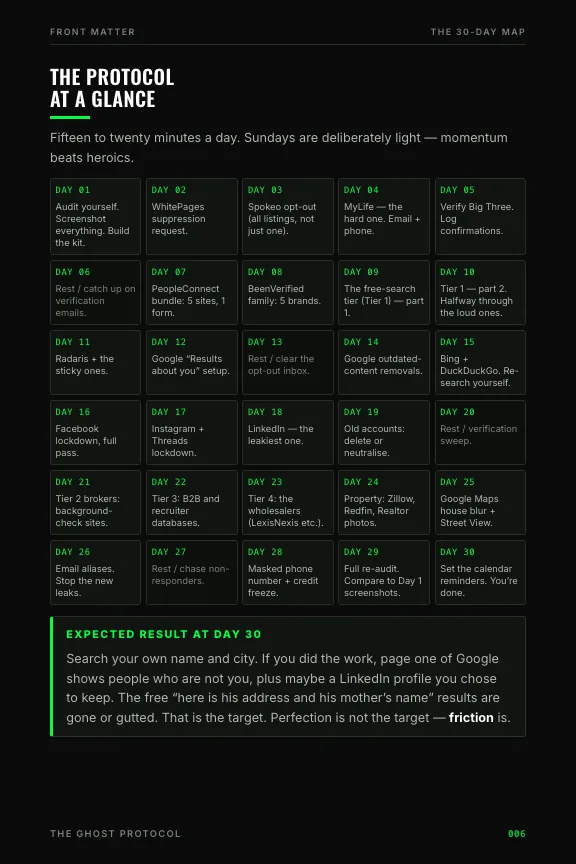
WhitePages, Spokeo and MyLife — the three results that show up first when someone searches your name. Exact forms, exact wait times, and the verification step where most people silently fail without ever realising the request didn't go through.
60+ brokers, sorted by damage
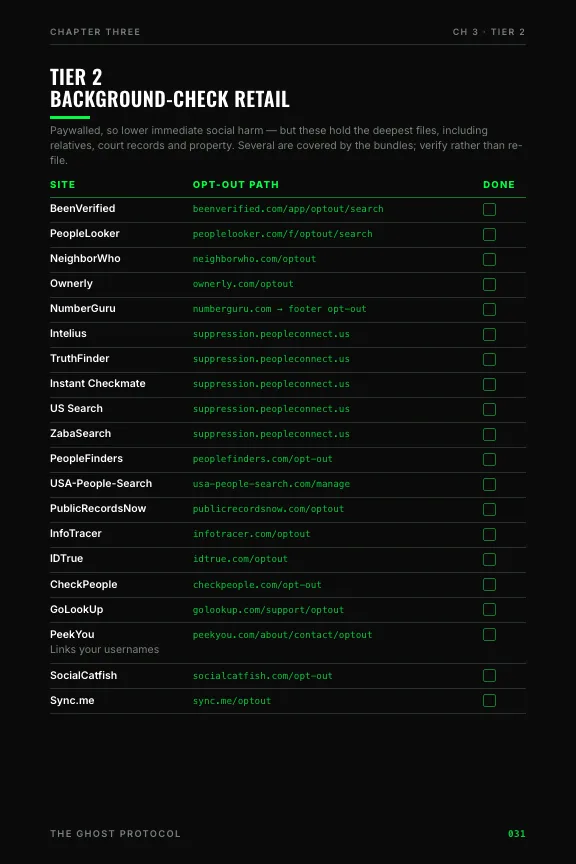
Five tiers, from the free sites publishing your address today to the wholesalers feeding everyone else. Plus the bundles — one form that clears five sites at once, because half of these "different" companies share one database.
Google & Bing erasure
The removal tools most people have never opened, in the order that actually works. Clear the search result before you kill the source page and it simply comes back at the next crawl — that's the mistake nearly everyone makes.
The Invisible Home
Blur your house on Street View permanently. Pull the interior photos off Zillow and Redfin — floor plan, entry points, whether you have a dog. And structure the next purchase so your name never reaches the deed index.
The lockdown checklist
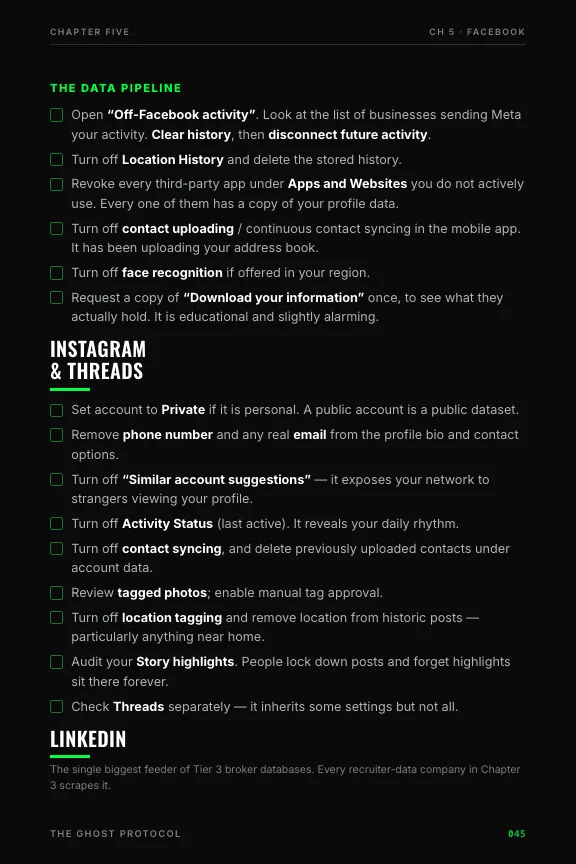
Line by line for Facebook, Instagram and LinkedIn. Not "set it to private" — the specific settings that leak your birthday, your family tree and your daily routine to scrapers regardless of who can see your posts.
The maintenance schedule
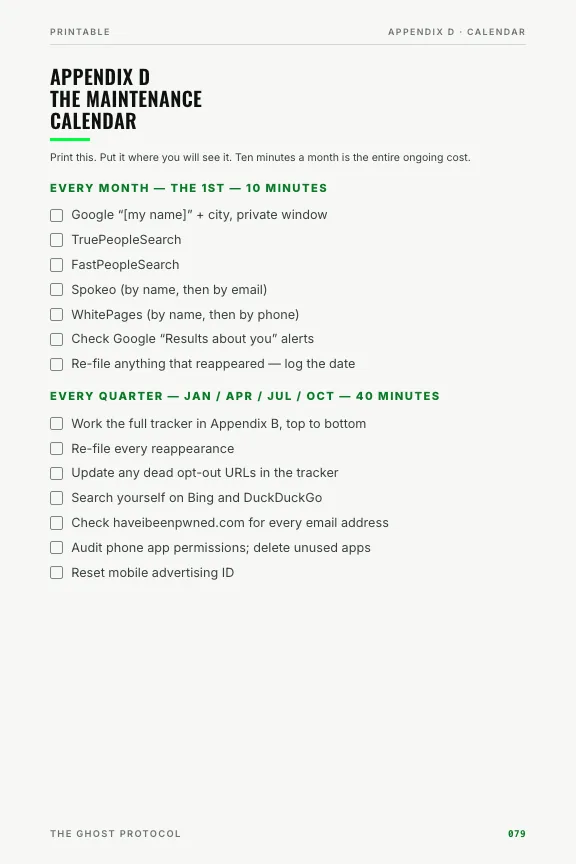
You will reappear. It's a refresh cycle, not a failure. Ten minutes on the first of the month, a printable calendar, and a tracker you tick with a pen — so the second time costs you two minutes, not another weekend.
What this costs
anywhere else.
Not invented "values" — the actual market price of buying each piece of this separately.
| What you're getting | Cost elsewhere |
|---|---|
| Removal from 60+ data brokersYear one of any done-for-you removal service | $100–200 |
| Staying removed, year two onwardThe same service, again, every year, forever | $100–200 / yr |
| Copy-paste legal request templatesStandard, GDPR Article 17, escalation, regulator complaint | ~$75 / hr |
| The trust & registered-agent briefingCh. 6 — what to ask before you buy property in your own name | $200+ / hr |
| Printable tracker, calendar & master link tableFive appendices built to be printed and ticked | — |
| Every future edition, freeBroker URLs die constantly. Updates land in your library. | — |
| First year, done for you | $375+ |
| This book, once | $10 |
You are paying for the route, not the labour. The clicking is yours to do — that's exactly why it costs ten dollars instead of a hundred and twenty-nine a year.
Real pages.
Unedited spreads from the book. Swipe through — this is what you're actually buying.


Eighty-two pages.
No filler.
Written to be worked through, not admired. Every chapter ends with something you have actually done.
- 00The $5 ScandalFind yourself in 90 seconds. Screenshot it.p.07
- 01The Architecture of ExposureWho sells you, how they got you, who buysp.13
- 02The Immediate TakedownWhitePages, Spokeo, MyLife — tonightp.20
- 03The 50-Point SweepEvery broker that matters, with linksp.26
- 04Google & Bing ErasureKilling the cache and the search resultp.36
- 05Social Media LockdownStop leaking location, birthday, contactsp.42
- 06The Invisible HomeDeeds, trusts, Zillow, Google Mapsp.48
- 07Stop the BleedingAliases, masked numbers, a ghost addressp.53
- 08The Maintenance Schedule10 minutes a month, foreverp.60
- A–EAppendices & printablesMaster link table · 50-broker tracker · copy-paste removal templates · maintenance calendar · glossaryp.67
Delivered as a PDF, formatted for phone and desktop. The tracker and calendar pages are laid out light so they print cleanly.
Why this book
exists.

I went looking for my own address after a friend found hers on a people-search site in about a minute. I found mine, my previous four addresses, my mother's name, and a satellite photo of my roof — on the free tier, before any paywall.
Then I tried to remove it. The information exists, but it's scattered across a few hundred blog posts, half of them written by removal services who'd rather sell you a subscription, and a lot of them out of date. I spent about forty hours working it out properly and writing down what actually happened at each site — the forms that break, the confirmations that never arrive, the ones that need a phone call.
This book is those forty hours, in order, so you don't repeat them.
What I'm not: a lawyer, a former intelligence officer, or anyone with a certification to wave at you. This is a well-researched practical manual written by someone who did the work and documented it carefully. If you want credentials, the book cites the public registries and regulator tools it's built on — check them yourself. That's the whole point of it.
- Every opt-out link tested at the time of writing, with a method for finding the current one when it moves
- Sources are public: state data-broker registries, regulator complaint portals, each company's own privacy page
- Updated quarterly — dead links are the one thing that would make this book worthless
There are no
testimonials here yet.
This launched recently. I could have written five glowing quotes and attached stock photos to them — a lot of pages at this price do. I'd rather tell you what's actually true and let the book carry itself.
So here's what you can verify without trusting me at all:
Search "California data broker registry". It's a public, free, searchable list of the companies that hold your data, and every registered broker must publish a working opt-out URL on it. Chapter 3 of this book is built on top of that registry and teaches you to use it.
If that registry looks like something you'd happily work through alone, you genuinely don't need me — go and do it, and I mean that. If it looks like six hours of tab-juggling you'd rather have pre-sorted into what to do tonight, this week and this month, that's the ten dollars.
Who this is for —
and who it isn't.
- You ran the audit at the top of this page and didn't like what came back.
- Someone found you who shouldn't have.
- You've been quoted $100+ a year and would rather learn it once.
- You're about to move, buy a house, or register a business — all three dump fresh public records with your address on them.
- You'll spend six evenings on this over a month.
- You want a button that does it for you. This is manual work — that's the point, and it's the price.
- You expect to vanish. Court records and property deeds stay public; the book says so on page one.
- You're in immediate danger. Call the police first. The introduction tells you exactly who else to call, and it's not me.
- You won't do the ten minutes a month. You'll reappear, and you'll blame the book.
You cannot
lose money here.
Work the first three chapters. That's the audit, the Big Three takedown, and the start of the sweep — maybe two evenings.
If you don't feel meaningfully safer at the end of it, message me and I'll refund you in full. No form, no "what went wrong" interrogation, no clawing the file back. You keep the book.
I'd rather have your trust than your ten dollars. And frankly, if the book doesn't work for you I want to know why, because I update it.
Refunds are handled through the checkout platform, so you're not relying on my goodwill alone.
Every objection
I've heard.
How long does this actually take?
I already pay for DeleteMe or Incogni. Is this redundant?
Will this remove me from Google entirely?
I'm not technical. Is this over my head?
I tried removing myself before and they put me back.
Does this work outside the United States?
Won't the links be dead in six months?
Can't I find all this for free?
Is any of this illegal or shady?
What format is it, and can I print it?
Is this a subscription? Will I be charged again?
How do I get it after paying?
What if it doesn't help me?
Less than a pizza. Less than one month of a VPN. Roughly a tenth of what a removal service charges you every single year to press the buttons this book hands you.
Instant access · read on phone or desktop, keep the PDF
P.S. — If you scrolled straight here, do one thing before you decide: go back to the top and run the ninety-second audit with your own name in it. Nothing on this page will convince you as effectively as that will, in either direction.
If it comes back clean, close the tab and keep your ten dollars — I'd rather that than a refund. If it doesn't, you now know exactly what a stranger can buy about you for $4.99, and the removal route is one click away.